Outsourcing medical billing: what it costs and what you give up
Outsourcing medical billing means handing claim submission, payment posting and denial follow-up to a third party, normally for a percentage of what they collect. It usually works. What it costs you is not the fee — it is visibility into which claims quietly stopped being chased.
- No sales call to read this
- Written by the team behind Klar
What you actually hand over
Five things move to the billing company. Four of them are fine to hand over. The fifth is the one to negotiate hard on.
Claim submission
Fine to outsource. It is high-volume, rule-driven work and a good partner is better at it than an overloaded in-house team.
Payment posting
Fine to outsource, provided you can still see the postings against your own ledger without asking.
Patient billing
Fine, but check the tone of their statements and their collections policy. Patients read them as coming from you.
Reporting
Fine, but insist on claim-level detail. A monthly summary tells you what happened, not what was decided.
Denials and appeals
This is the one. Every billing company says they work denials. Almost none will tell you what share of denied dollars they appeal, and that number is the whole value of the contract.
The cost that never appears on an invoice
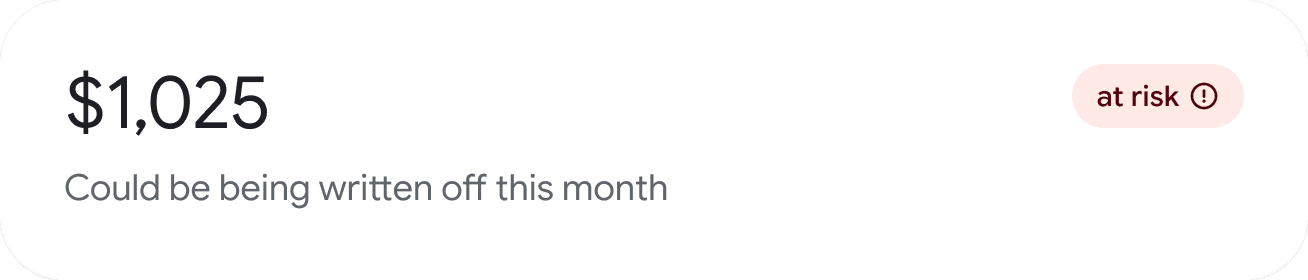
A billing company's fee is visible every month. What is not visible is the claim that got denied, sat in a queue behind easier work, aged past its filing deadline and became an adjustment. Nobody decided to write it off. It just ran out of time.
That is not a moral failing of billing companies. Their billers are paid to clear volume, and a large denial with a complicated appeal takes ten times as long as a small one. Any human queue prioritizes the same way.
It is why the useful question in a sales conversation is not "do you work denials" — everyone says yes — but "what percentage of denied dollars did you appeal last quarter, and can you show me by reason code".




Questions that separate a good partner from an expensive one
Ask these on the first call. The answers vary far more than the pricing does.
| Ask them | What a good answer sounds like |
|---|---|
| What percentage of denied dollars did you appeal last quarter? | A number, broken down by reason code. "We work all of them" is not a number. |
| What happens to our existing AR on day one? | They work it from the start, oldest-and-largest first, and tell you which claims are already past appeal. |
| Can I see claim-level activity without asking you? | Yes, in a system you can log into. Monthly PDFs are a summary, not visibility. |
| Who actually touches our claims, and where? | A straight answer. Offshore is not disqualifying; not knowing is. |
| How are you paid on money we would have collected anyway? | Most are paid on everything collected. Ask what the fee looks like on clean claims that never needed them. |
| What is the exit? Who owns the data? | You do, in an exportable form, with a defined transition period. Get it in the contract. |
Outsourcing is not the only answer
Two alternatives worth pricing against a billing contract, including one where Klar is the wrong choice.
Keep it in-house and change the tooling
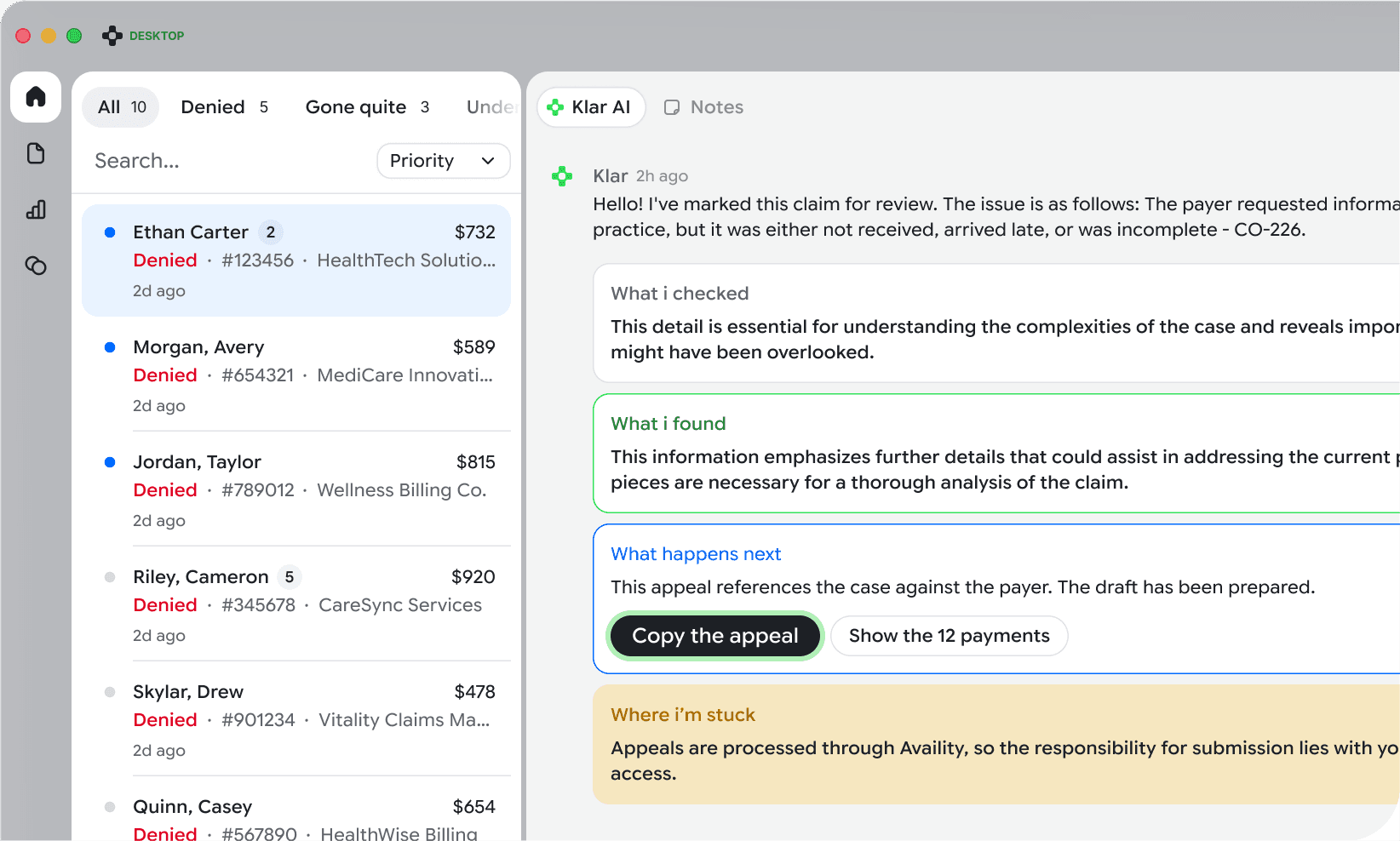
If claims go out cleanly and the problem is denials sitting unworked, the bottleneck is reading and drafting time, not headcount. That is what Klar was built for: it reads every remittance, ranks the queue by value, and drafts the appeal for a person to approve.
This works when someone in the practice can spend twenty minutes a day on approvals. If nobody can, outsourcing is genuinely the better answer and we would rather you knew that now.
Outsource, and put Klar underneath it
Billing companies license Klar to run their own book. If you are happy with your partner but want to see the claim-level activity yourself, that is a conversation to have with them rather than a reason to switch.
It also changes the answer to the appeal-rate question, because the ranking and drafting stop depending on how full a biller's queue is that week.
Questions about outsourcing, answered
Still unsure? Contact usOften, yes — particularly if claims are going out late, your biller is a single point of failure, or you are growing faster than you can hire. It is a poor idea if your real problem is denials going unworked, because a billing company's queue prioritizes the same way your own does. Diagnose which problem you have before you buy a solution to the other one.
Almost always a percentage of collections, with the rate varying by specialty, claim volume and how much of the cycle they take on. Some charge per claim instead. The number to compare is not the headline rate — it is what you pay on clean claims that would have been collected without them.
Handing some or all of the revenue cycle to a third-party company: submitting claims, posting payments, billing patients, working denials and reporting. Your practice keeps the clinical work and the payer contracts; they run the administrative cycle around them.
Not in the way the question implies. The reading and drafting — decoding remittances, ranking what is worth chasing, writing the first version of an appeal — is work software does well. The judgment calls, the payer phone calls and the decision to escalate are not. Klar is built on that split deliberately: it drafts, a biller decides.
This is the most commonly skipped question in a transition. Some partners work legacy AR from day one, some quote it separately, and some quietly do not touch it. Ask explicitly, and ask which of those claims are already past appeal, because that number is the real cost of having waited.
The claim submission side moves quickly. The risk sits in the handover: unworked denials in the old partner's queue, in-flight appeals, and whoever holds the clearinghouse relationship. Agree in writing who works claims filed before the switch date.