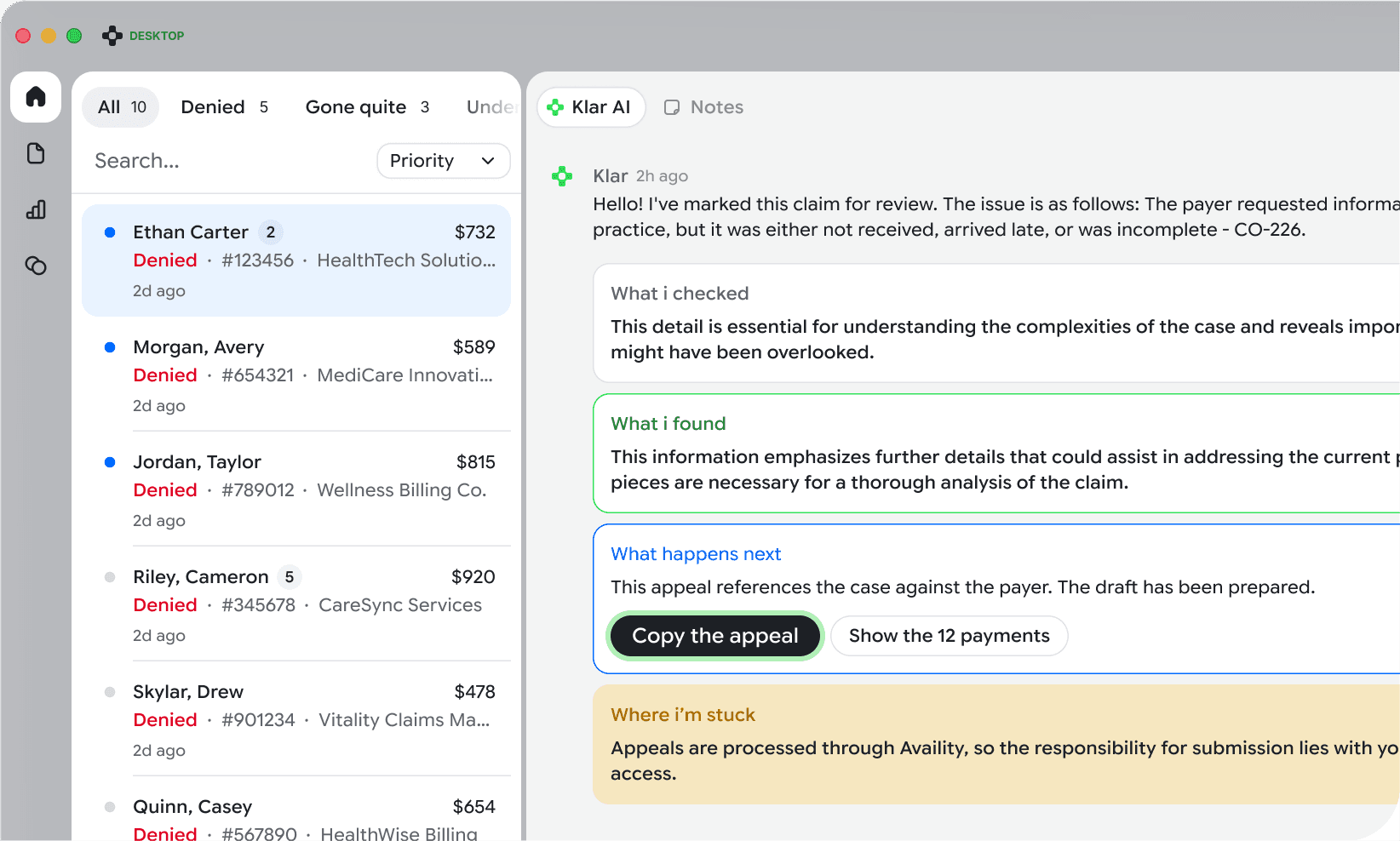
Your billers are good. There just aren't enough of them.
Klar licenses to third-party billing companies as the platform their team works in. It reads every client's remittances, ranks the queue across the whole book by recoverable dollars, and drafts the correction or appeal — so your billers spend their day deciding rather than reading.
- Multi-client from day one
- Keeps each client's clearinghouse
- Per-practice routing by tax ID
Denial work is the part of your book that does not scale
Claim submission scales with software. Payment posting scales with software. Denial work scales with headcount, because someone has to read the remittance, work out what this payer wants on this claim, and decide whether the appeal is worth writing.
So the honest constraint on a billing company is not sales, it is how many experienced billers you can find and keep. Take on more clients and the denials from the new book go to the back of the same queue — which is exactly where the margin was supposed to come from.
Klar takes the reading and the drafting. Your billers keep the judgment, the payer relationships and the client conversations, and the queue stops being ordered by whoever shouted most recently.



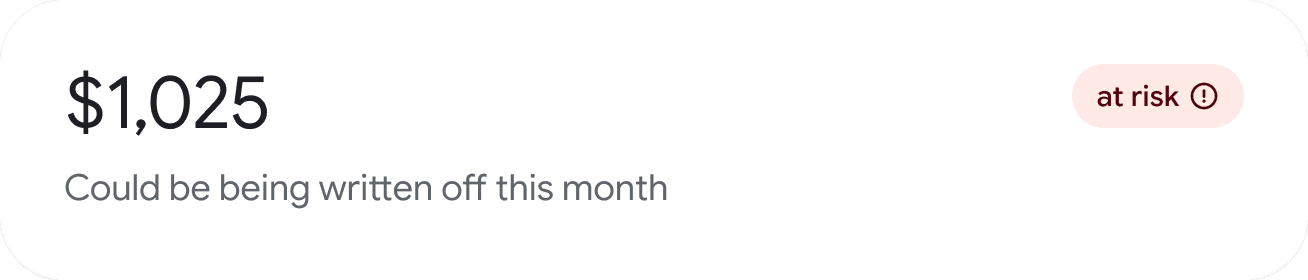

Built for a book of clients, not one practice
Every practice you bill for is a separate provider record with its own payers, its own clearinghouse feed and its own filing windows. Klar was built that way from the first version.
Multi-client by design
Each client practice is its own provider record, routed by billing NPI and tax ID. One Klar account holds the whole book without claims crossing between clients.
Reads each client's own feed
Klar reads the remittance files each practice already receives. No client has to re-enroll anywhere, and nobody's existing feed gets cut off.
One queue, ranked across the book
Work is ordered by recoverable dollars and remaining filing time across every client, so the largest recoverable claim gets worked first regardless of whose it is.
Corrections and appeals drafted
The next step arrives written with the evidence attached. Your biller approves, edits, or says it has the wrong plan — which teaches Klar rather than being discarded.
Payer knowledge that stays
What worked on a payer for a code stays on the record. When a biller leaves, what they learned about that payer does not leave with them.
What changes, by who you are
Three people in the room care about different things. Here is the honest version for each.
| Role | What changes | What does not |
|---|---|---|
| Owner | Denial capacity stops being a function of headcount, so taking on a client is a commercial decision rather than a hiring one. | You still need experienced billers. Klar makes each one cover more; it does not replace the judgment or the payer calls. |
| Biller | The day starts with a ranked queue where the reading is done and the appeal is drafted, instead of an aging report and a stack of remittances. | They still decide. Nothing goes to a payer without a person approving it, and they can tell Klar it has the wrong plan. |
| Client practice | They can see claim-level activity as it happens rather than a monthly summary, which is usually the thing they were unhappy about. | Their EHR, their clearinghouse and where their money is routed all stay exactly as they are. |
How licensing works
Onboarding a client
Add the practice as a provider record with its billing NPI and tax ID, point Klar at the remittance feed they already receive, and import their open AR. Klar works the existing backlog from day one, which is normally where the recoverable money is concentrated.
There is no payer re-enrollment. That matters more than it sounds: a payer routes each provider's remittances to exactly one receiver, so enrolling a new one would cut off the feed the practice already depends on.
What it costs you
Klar is priced on performance — a share of the additional revenue the platform recovers — rather than on how many billers you seat.
Tell us how many practices you bill for and roughly what your monthly claim volume looks like, and we will work out what that means for your book against what the same work costs you in biller hours today.
Questions billing companies ask
Still unsure? Contact usNo. Klar does the reading, the ranking and the first draft; your billers do the deciding, the payer calls and the escalations. A platform that acts unsupervised in this domain gets things wrong at volume, which in billing means wasted appeals and missed filing deadlines. Every outbound step is approved by a person.
No. Klar sits alongside it and takes the denial and AR work off it. Your team keeps filing and posting where they file and post today, and each client keeps their own clearinghouse.
Every practice is a distinct provider record keyed on billing NPI and tax ID, and claims route by that key. Access is scoped per practice, so an audit for one client does not involve another client's book.
The practice is the covered entity, you are its business associate, and Klar sits under you as a subcontractor — so the agreement we sign is with you, not with your client. We will walk your counsel through the specifics rather than hand you a summary.
Not architecturally — your team can work in Klar from wherever they are. It tends to help more, not less, because the reading and the payer context are the parts hardest to transfer to a team that has not sat in that payer's portal for five years.
That is the sensible way to start, and it is what we would suggest. Pick one practice with a visible AR problem, run their existing backlog through Klar, and judge it on what comes back rather than on a demo.