Denial management in medical billing: what it is and how to do it
What denial management is, how to read a denial, the deadlines that matter, and a five-step process for recovering denied claims and preventing new ones.
By the Klar team · Updated
Denial management is the work of finding out why a payer refused or short-paid a claim, fixing or appealing it before the deadline, and changing whatever caused it so the same denial stops coming back. Done well, it recovers money you have already earned and lowers the number of denials you get next month.
How common are claim denials?
Common enough to measure, and public data is thin. One of the few sources is the ACA marketplace, where insurers have to report their numbers. In 2024, insurers on HealthCare.gov denied 19% of in-network claims, and the rate ran from 3% to 36% depending on the insurer. Consumers appealed fewer than 1% of those denials, and insurers upheld 66% of the appeals that were filed.
KFF reports those as appeals by consumers, so they do not show how billing teams do. The point holds either way: a denial that nobody works is money nobody collects.
For a single practice, the American Academy of Family Physicians puts the industry average denial rate at 5% to 10% and says keeping it below 5% is more desirable.
Why do claims get denied?
The same marketplace data includes the reasons insurers reported for in-network denials in 2024. KFF’s breakdown:
| Reason the insurer reported | Share of denial reasons |
|---|---|
| Other, with no reason specified | 36% |
| Administrative, such as a duplicate claim, missing information, late filing or an unapproved provider | 25% |
| The service is excluded from the plan | 13% |
| No prior authorization or referral | 9% |
| Medical necessity | 5% |
The rest fell into other categories, such as a benefit limit that had been reached or a member who was not covered.
Two things stand out. A quarter of the reasons were administrative, the kind a practice can usually prevent before the claim goes out. And only 5% were about medical necessity, the kind that takes a clinical argument to overturn.
The mix varies widely from one insurer to the next, so your own remittances are a better guide than any national figure.
What is the difference between a rejection and a denial?
A rejected claim never made it into the payer’s system. It failed a check on the way in, usually a formatting problem, a missing field or a member ID that did not match, and it comes back from the clearinghouse or the payer’s front end. You fix it and send it again. There is nothing to appeal, because the payer never made a decision. Medicare’s claims processing manual says as much: a claim returned as unprocessable is not considered a claim, is not denied, and has no appeal rights.
A denied claim was received and processed, and the payer decided not to pay all or part of it. The decision arrives on the remittance with a reason code. Depending on the reason, you send a corrected claim or you appeal.
The difference matters for deadlines. A rejected claim generally does not count as filed, so the filing deadline keeps running until a corrected version is accepted.
What are the two types of denials?
Billers usually split denials into soft and hard.
| Type | What it means | What to do |
|---|---|---|
| Soft denial | Temporary. The payer needs something corrected or added before it will pay. | Fix the claim or send the missing information, then resubmit. |
| Hard denial | Final unless you appeal. The payer has decided the claim is not payable as submitted. | Appeal if the decision is wrong. If it is right, close it out on purpose, as a write-off or a patient balance depending on the reason, and fix the cause. |
How do you read a denial?
Every denial on an electronic remittance carries codes that say what the payer did and why. Three of them matter.
The group code says who is responsible for the amount. X12, the standards body that publishes the code lists, defines four.
| Code | Name | In practice |
|---|---|---|
| CO | Contractual Obligation | The practice absorbs it under its contract with the payer. It generally cannot be billed to the patient. |
| PR | Patient Responsibility | The patient owes it: a deductible, coinsurance or copay. |
| OA | Other Adjustment | No other group code applies, for example an adjustment that reflects what another payer already paid. |
| PI | Payor Initiated Reduction | The payer says the amount is not the patient’s to pay, but there is no contract with the provider behind the adjustment. |
The descriptions of CO, OA and PR follow CMS’s manual for Medicare remittance advice. Other payers use the same codes, but check how each one applies them.
The reason code, or CARC, describes why the claim or line was paid differently than it was billed. The remark code, or RARC, adds the detail the reason code leaves out.
Read them together. Reason code 16 says the claim lacks information or has a billing error, which on its own tells you very little. Paired with remark code N822, missing procedure modifier, it tells you what to fix.
What are the steps in denial management?
There is no single official list, but most versions cover the same five steps.
- Catch every denial. That includes the line that was refused on a claim that otherwise paid. A partly paid claim looks finished, which makes it an easy denial to miss.
- Sort by cause and by value. Group denials by payer and reason code, and put a dollar figure on each group.
- Fix or appeal. A soft denial gets a corrected claim. A hard denial that is wrong gets an appeal, with the documentation that answers the payer’s stated reason.
- Follow it to payment. A resubmitted claim is not a paid claim. Track each one until the money posts or the payer gives a final answer.
- Prevent the repeat. Take the top causes back to where they start: registration, authorization, documentation or coding.
What are the deadlines?
Every denial has two clocks: the deadline to file a corrected claim and the deadline to appeal. Miss either one and the money is usually gone, however strong the case was.
Medicare publishes its deadlines.
| Step | Medicare deadline |
|---|---|
| File the claim | Within one calendar year of the date of service |
| First appeal (redetermination) | 120 days from receiving the initial determination |
| Second appeal (reconsideration) | 180 days from receiving the redetermination decision |
Medicare has five levels of appeal in all. Commercial plans and Medicaid programs set their own windows, in the contract or the provider manual, and they vary by payer. Look them up for your largest payers and keep them where your billers can see them.
Which denials should you work first?
A common habit is to work the oldest first. It feels disciplined, but the oldest claims are the ones most likely to be past their deadline already.
Rank by two things instead: how much is recoverable and how much time is left. A large denial with three weeks until its appeal deadline goes ahead of a small one from last quarter.
How do you prevent denials?
Prevention happens before the claim is filed.
- Verify eligibility and benefits before the visit, including which plan actually administers the benefit.
- Track prior authorizations and when they expire, not just whether one was obtained.
- Make sure the note supports the code, especially for time-based services.
- Keep credentialing current for every clinician and every plan.
- Review your top denial reasons every month, and check whether last month’s fix worked.
Then measure it. Denial rate is one of the five revenue cycle KPIs worth tracking every month.
Where Klar fits
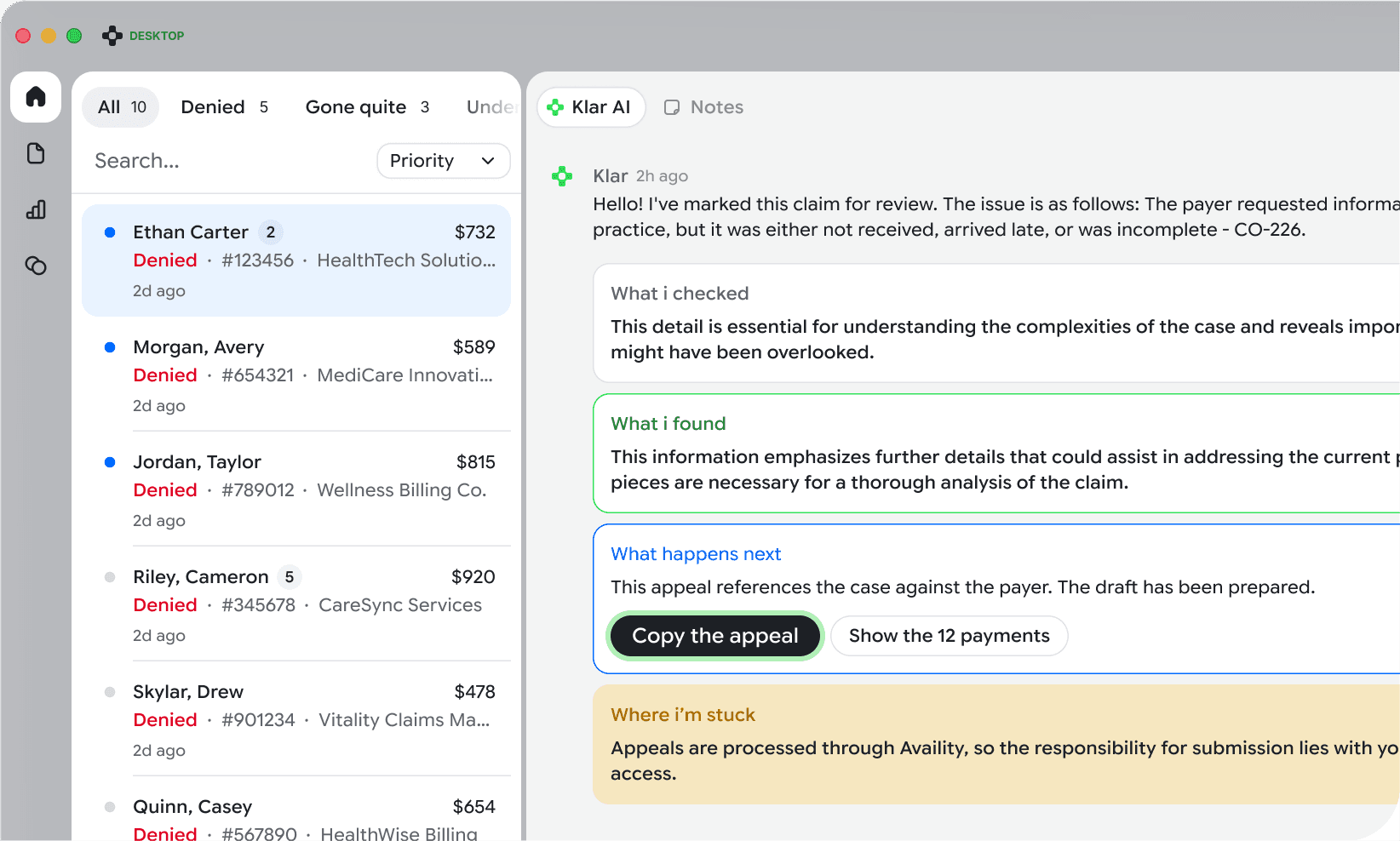
Klar works claims end to end, from submission to payment. It checks every claim before it goes out, reads every remittance, ranks denials by what they are worth, and drafts the correction or appeal for a biller to approve. The volume goes to software and the judgment stays with your team.
See how it works on the denial management software page.
This article is general information for medical practices. It is not legal, coding or compliance advice. Payer rules vary and change, so check the current rule with the payer before you act on it.