Denial management software that works the denial, not just the list
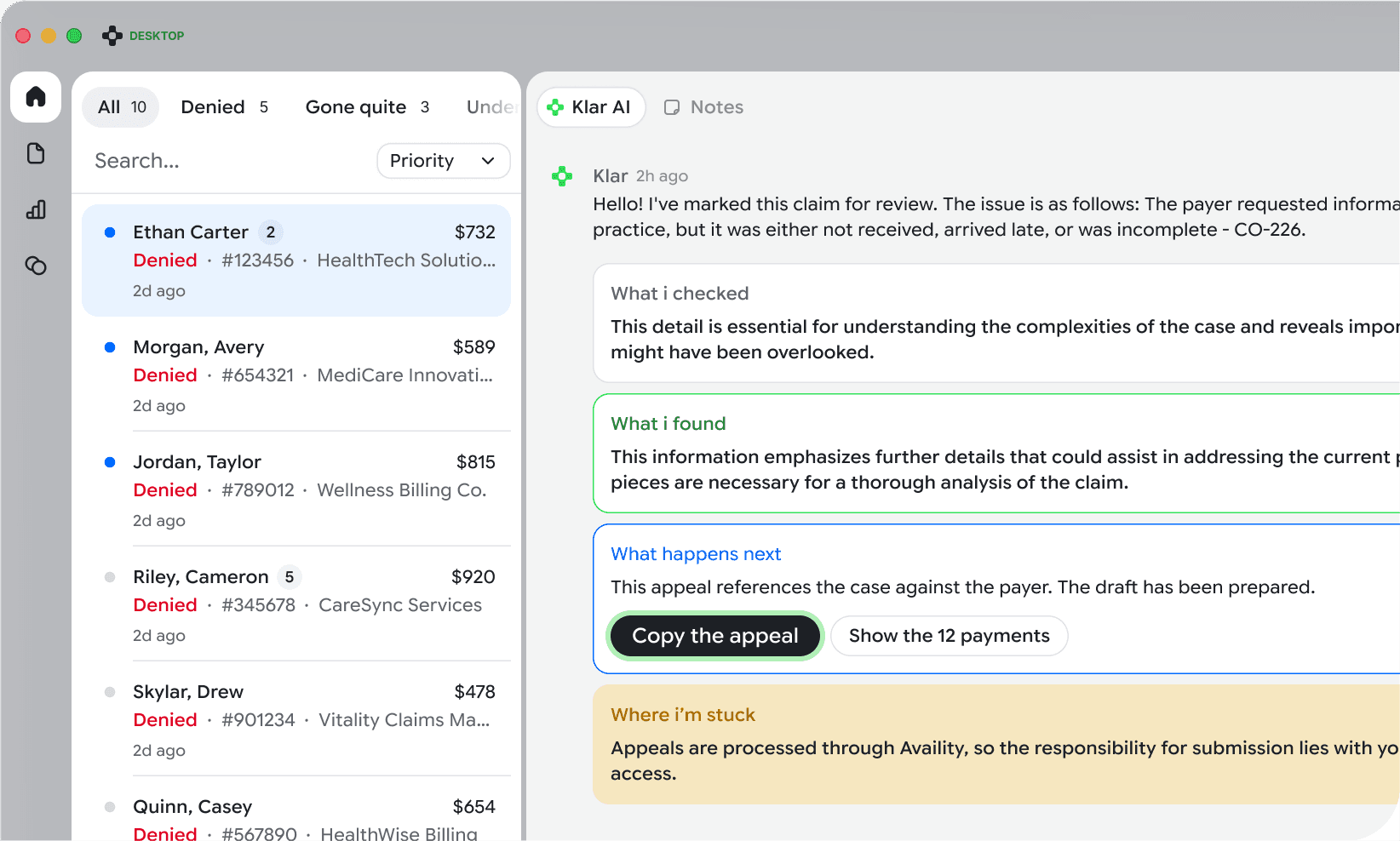
Denial management software finds denied and underpaid claims, works out why the payer refused them, and gets them appealed before the filing window closes. Most of it stops at the first step. Klar reads the remittance, states the reason in plain English, and drafts the appeal for a biller to approve.
- Reads 835 remittances directly
- CARC and RARC decoded
- Works with your EHR
A worklist is not denial management
Most denial tools produce a list. Claim number, payer, dollar amount, a reason code, and a date. Everything after that is still a person opening the remittance, working out what CO-16 with an N822 actually means for this payer, deciding whether it is worth appealing, and writing the letter.
That is the expensive part, and it is the part that does not get done when the queue is full. A list of two hundred denials does not help a biller who can work fifteen a day — it just tells them how far behind they are.
Klar does the reading and the drafting. The claim arrives with the payer's codes decoded, what Klar checked, and a prepared next step. Approving takes a read rather than an investigation.


From remittance to appeal, without the portal hunting
Reads the 835 directly
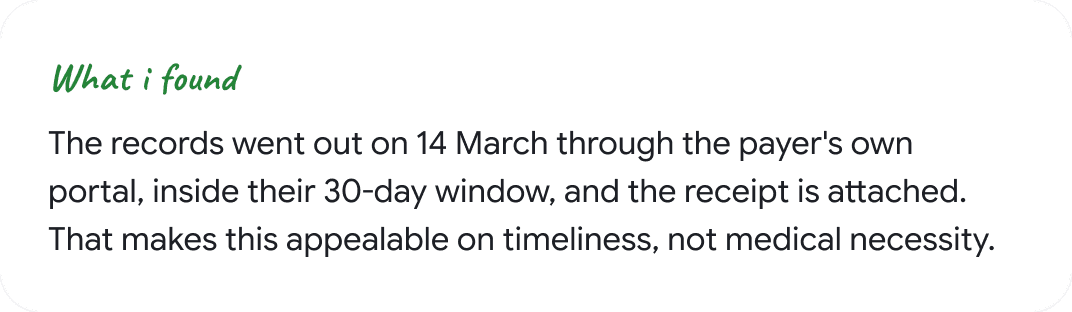
The remittance file your clearinghouse already delivers is the authoritative record: reason codes, remark codes, paid amounts, adjustments. Klar reads it as it comes in.
Decodes CARC and RARC
Reason and remark codes become a sentence a biller can act on, with the official wording of each code kept alongside.
Ranks by what it is worth
The queue is ordered by recoverable dollars, not by age or by whichever claim is quickest, so the large denial never sits behind a small adjustment.
Drafts the correction or appeal
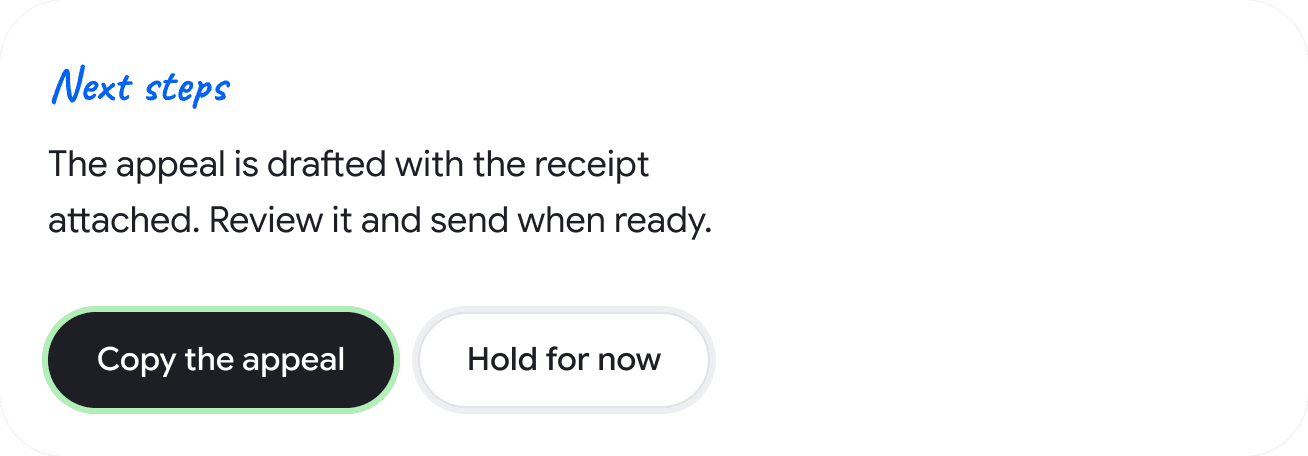
The next step arrives written, with the evidence Klar used attached. Your biller edits, approves, or says it has the wrong plan.
Watches the filing clock
Anything approaching a timely filing deadline is surfaced while it can still be appealed, rather than showing up later as an adjustment.
Remembers the payer
What worked on this payer, for this code, on this service — kept on the record so the same denial does not have to be worked out from scratch again.
What happens to a denied claim
Five stages. A person signs off on anything that leaves the building.
| Stage | What Klar does | What your team does |
|---|---|---|
| Ingest | Reads the 835 from the clearinghouse feed you already receive. No new payer enrollment. | Nothing. |
| Decode | Translates the reason and remark codes into what the payer is actually asking for on this claim. | Nothing. |
| Triage | Separates the fixable from the genuinely uncollectable, and ranks the fixable by recoverable dollars. | Nothing. |
| Draft | Prepares the correction or the appeal with the evidence attached, and shows what it checked to get there. | Approves, edits, or tells Klar it has the wrong plan. |
| Confirm | Watches for the payer response, confirms the money landed, and records what worked for next time. | Nothing. |
Questions about denial management
Still unsure? Contact usThe process of finding out why a payer refused or short-paid a claim, correcting whatever caused it, appealing where the refusal is wrong, and feeding what you learn back so the same denial stops happening. The reactive half recovers money already lost; the preventive half is what makes the number go down.
Usually split into soft denials, which are temporary and can be resolved without an appeal — missing information, pending review; hard denials, where the payer refuses and the money is lost without a successful appeal; and clinical denials, which turn on medical necessity or level of care and need documentation rather than a coding fix.
It depends which end of the claim is failing. If claims are being rejected before adjudication, you need better scrubbing at submission. If they are being adjudicated and denied, you need something that reads remittances and works the denials. Tools that do the first are often assumed to do the second, and mostly do not.
Most produce a prioritized list and stop. The measure to apply is what happens between a denial appearing on a screen and an appeal being sent — if that is still entirely a person, the software has surfaced the work rather than done any of it.
No. Klar reads the 835 remittance files your practice already receives, so there is no new enrollment and no change to where your money is routed.
No, and that is deliberate. Klar drafts and ranks; a person approves anything that goes to a payer. Software acting unsupervised at volume in this domain means wasted appeals and missed filing deadlines at volume.