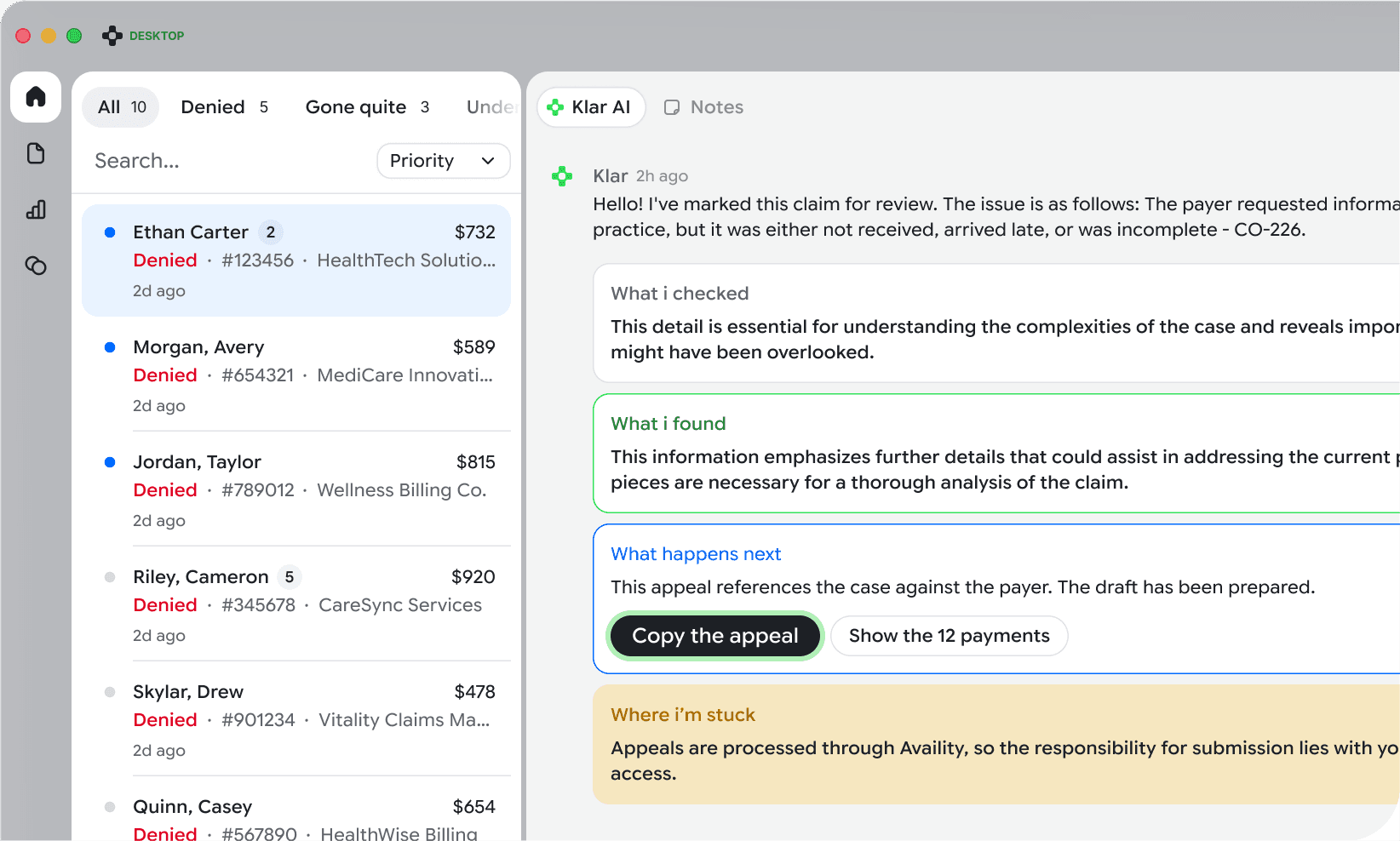
How to audit your medical billing
How to run a medical billing audit: how often, how many claims to sample, what to check, and what to do with what you find. Based on OIG guidance.
By the Klar team · Updated
A medical billing audit is a structured check of whether your claims match your documentation, whether payers paid what they owed, and where money is being lost along the way. A small practice can run a useful one with a sample of claims and a handful of reports.
What does a medical billing audit look for?
Two different things, and a good audit covers both.
The first is accuracy: were the claims right? The Office of Inspector General’s compliance guidance for individual and small group physician practices, published in 2000, says a practice’s self-audits can show whether bills are accurately coded and reflect the services documented, whether documentation is completed correctly, and whether the services provided were reasonable and necessary.
The second is revenue: were you paid what you were owed? That means looking at denials nobody worked, claims paid below the contracted rate, and write-offs that should not have been written off.
How often should you audit your billing?
The OIG guidance recommends starting with a baseline audit, then running periodic audits at least once each year. The baseline sets the method, how you pick records and what you check, so that later audits can be compared with it.
How many claims should you review?
There is no set formula. The OIG’s basic guide is five or more medical records per federal payer, or five to ten per physician, ideally chosen at random. A larger sample gives you more confidence in what you find.
Random matters. If the person who did the billing picks the claims, you are auditing their best work.
What should a billing audit check?
| Area | What to pull | What you are looking for |
|---|---|---|
| Coding and documentation | A random sample of claims with their notes | Codes and modifiers the note supports. Nothing billed that was not documented. |
| Denials | Denials by payer and reason code | The same cause repeating. Denials that were never worked. |
| A/R aging | An aging report by payer | Balances past 90 and 120 days. Claims close to a filing or appeal deadline. |
| Adjustments and write-offs | Adjustments by code | Missed-deadline and no-authorization write-offs recorded as contractual adjustments. |
| Payments | Remittances against your fee schedules | Claims paid below the contracted rate. |
| Credit balances | A credit balance report | Money owed back to payers or patients. |
The adjustments row is easy to skip. The American Academy of Family Physicians warns that mixing contractual and non-contractual adjustments gives a misleading picture of how well a practice collects. A write-off for a missed filing deadline is a loss, not a contract term.
Which billing errors draw the most scrutiny?
The OIG guidance lists the billing problems that have been among the most frequent subjects of its investigations and audits. They make a ready checklist for the claim-by-claim part of your review.
- Billing for a service that was not provided, or not provided as claimed.
- Billing for services, equipment or supplies that were not reasonable and necessary.
- Double billing that results in a duplicate payment.
- Billing a non-covered service as if it were covered.
- Misusing provider identification numbers, for example billing one clinician’s services under another’s number.
- Unbundling: billing separately for parts of a service that belong under a single code.
- Using coding modifiers incorrectly.
- Clustering: coding almost every visit at the same one or two middle levels.
- Upcoding: billing for a more expensive service than the one that was performed.
The same guidance draws a line between an honest mistake and a fraudulent claim. Either way, an error in your sample needs a cause and a fix.
How do you run a billing audit, step by step?
- Set the scope. Pick a period, such as the last full quarter, and decide which payers and clinicians are in.
- Pull a random sample. Use the OIG’s guide as a floor.
- Check each claim against the record. Was the service documented? Do the codes, modifiers and diagnoses match the note? Was it billed under the clinician who provided it?
- Run the reports. Denials, aging, adjustments, payments and credit balances, each broken down by payer.
- Count and price what you found. An error rate for the sample, and a dollar figure for each problem.
- Fix the cause, not just the claim. Retrain, change the template, or correct the rule in your system.
- Audit the same areas again next time. That is how you find out whether the fix worked.
What if the audit finds a problem?
Unworked denials and underpayments may still be recoverable if they are inside the payer’s deadline. Work the largest first. The post on denial management covers the deadlines and the order to work them in.
Overpayments are different. If you find you were paid too much, particularly by Medicare or Medicaid, there are rules about reporting and returning the money, and they come with deadlines. Talk to a health care attorney or compliance advisor before you decide what to do.
Should you audit a billing company you have outsourced to?
Yes. The OIG guidance is direct about it: a physician remains responsible to Medicare for bills sent in their name, even with no knowledge that anything was wrong.
In practice that means asking your billing company for claim-level access and for the same reports listed above. If they cannot produce a denial report by reason code or an adjustment report by category, that is a finding in itself. Our guide to outsourcing medical billing lists the questions to ask.
Internal or external audit?
An internal audit is cheaper and you can run it more often. The rule is that nobody reviews their own work.
An external audit is independent. It is worth paying for when you are setting your baseline, when billing is outsourced, or when the numbers look wrong and you cannot see why.
Where Klar fits
An audit is a sample, taken once or twice a year. Klar works claims end to end, from submission to payment, and reads every remittance as it comes in. The patterns an audit goes looking for, repeating denials, short payments and claims close to a deadline, show up while there is still time to act on them. That covers the revenue side. It does not replace a review of coding against documentation.
See how it works for practices.
This article is general information for medical practices. It is not legal, coding or compliance advice. Payer rules vary and change, so check the current rule with the payer before you act on it.