Denial codes, explained plainly
What the most common claim adjustment reason codes mean, why payers send them, and what billers usually check next.
How to read a denial code
A denial code on a remittance or EOB has two parts. The letters are the group code, which says who the payer holds responsible. The number is the claim adjustment reason code (CARC), which says why the amount was adjusted. Remark codes (RARCs) often appear next to it with more detail.
- CO, Contractual obligation:
- the payer is holding the provider responsible for the amount under its contract or the law.
- PR, Patient responsibility:
- the payer has assigned the amount to the patient, for example as a deductible, a copay or a service the plan does not cover.
- OA, Other adjustment:
- neither CO nor PR applies, which is common for informational adjustments such as a prior payer's payment.
Common denial codes
- CO-4
Modifier does not fit the procedure
CO-4 means the payer decided the modifier on a claim line does not fit the procedure code it was billed with, so the line was denied.Read - CO-11
Diagnosis does not support the procedure
CO-11 means the payer decided the diagnosis code on the claim does not support the procedure that was billed, so the service was denied.Read - CO-16
Missing information or a billing error
CO-16 means the claim is missing information or has a submission error, so the payer could not process it. A remark code next to it says what is missing.Read - CO-22
Another plan may need to pay first
CO-22 means the payer believes another insurance plan should pay first under coordination of benefits, so it will not pay until that plan has processed the claim.Read - OA-23
Effect of a prior payer's payment
OA-23 shows how a previous payer's payment or adjustment affected what this payer paid. It usually appears on secondary claims and is not a denial on its own.Read - CO-24
Covered under a capitation agreement
CO-24 means the service is covered by a capitation agreement or managed care plan, so the payer does not pay it separately on the claim.Read - PR-27
Coverage ended before the date of service
PR-27 means the patient's coverage had ended before the date of service, so the payer assigned the charge to the patient.Read - CO-29
Timely filing limit expired
CO-29 means the payer received the claim after its filing deadline, so it denied the claim. Because it is a CO denial, the patient is generally not billed for it.Read - CO-45
Charge is above the allowed amount
CO-45 means the billed charge was higher than the payer's allowed amount or contracted rate. The difference is a contractual adjustment, not a denial of the service.Read - CO-50
Not medically necessary
CO-50 means the payer decided the service was not medically necessary based on the information it had, so it did not cover it.Read - CO-59
Multiple procedure reduction
CO-59 means the payer reduced payment under multiple or concurrent procedure rules, for example when several procedures are done in the same session.Read - CO-96
Charge not covered
CO-96 means the charge is not covered by the payer. A remark code next to it usually explains why, and PR-96 means the amount was assigned to the patient.Read - CO-97
Bundled into another service
CO-97 means the payer considers this service part of another service it already paid on the same claim or date, so it does not pay for it separately.Read - CO-109
Sent to the wrong payer
CO-109 means this payer is not responsible for the claim and it should be sent to a different payer or contractor.Read - CO-119
Benefit maximum reached
CO-119 means the plan's benefit maximum for this service in the period, such as a yearly visit limit, has been reached, so the payer stopped paying.Read - CO-197
Authorization was missing
CO-197 means the payer required prior authorization, precertification or notification for the service and found none on file, so it denied the claim.Read - PR-204
Not covered by the patient's plan
PR-204 means the service, equipment or drug is not covered under the patient's current benefit plan, and the payer assigned the amount to the patient.Read - CO-226
Requested information not received from the provider
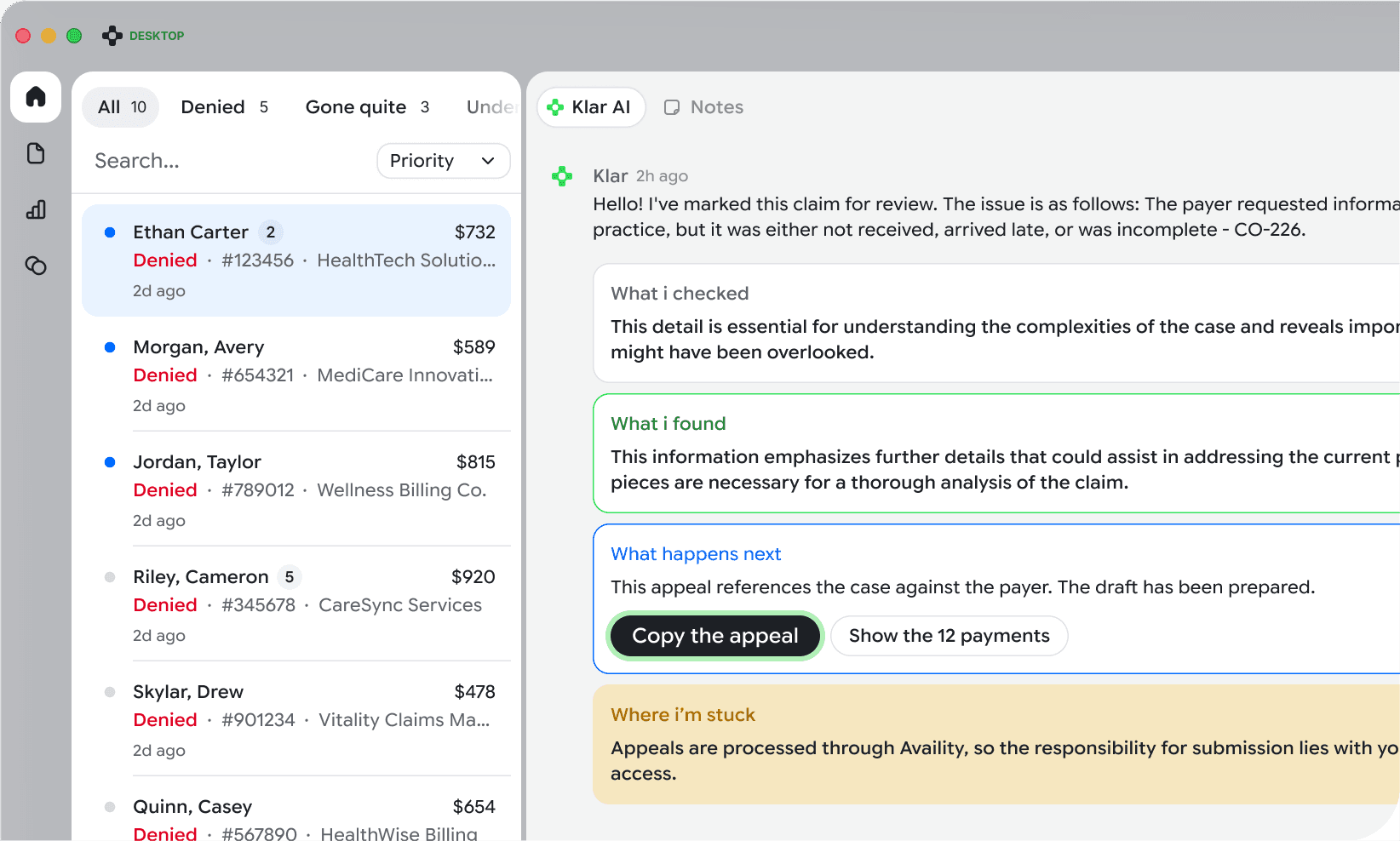
CO-226 means the payer asked the billing or rendering provider for information, such as medical records, and did not get it in time or in full.Read - PR-227
Requested information not received from the patient
PR-227 means the payer asked the patient or policyholder for information, often a coordination of benefits form, and did not receive it.Read - CO-234
Procedure not paid separately
CO-234 means the payer does not pay this procedure on its own, usually because it treats it as part of another service or as a code it never pays separately.Read - PR-242
Not provided by a network provider
PR-242 means the service was not provided by a network or primary care provider the plan requires, and the payer assigned the amount to the patient.Read - CO-252
Documentation is required
CO-252 means the payer needs an attachment or other documentation, such as medical records or an invoice, before it can decide the claim.Read - CO-253
Sequestration reduction
CO-253 is the sequestration reduction, a cut to Medicare payments that federal law requires, currently 2%. It is not a denial and there is nothing to correct.Read - PR-275
Prior payer's patient share not covered
PR-275 means the secondary payer will not cover the deductible, coinsurance or copay the primary payer left to the patient, so that amount stays with the patient.Read