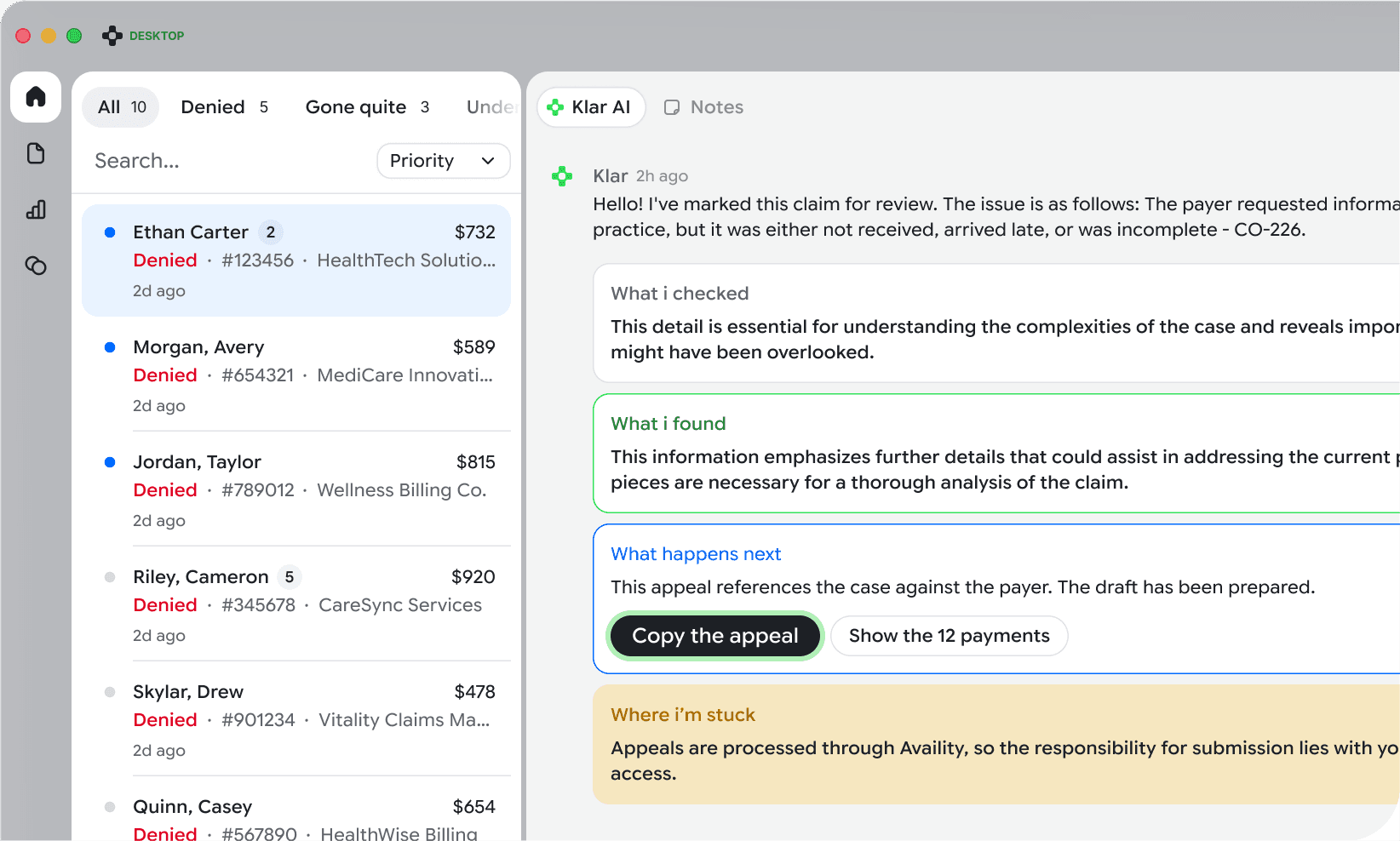
RCM software for teams that actually work the claims
Revenue cycle management software runs the money side of a practice: filing claims, tracking them to the payer, posting what comes back, and chasing what does not. Klar does all of it end to end, from submission to payment, including the part most platforms leave to a person: working every denial.
- Sits alongside your EHR
- Keeps your clearinghouse
- Every action visible as it happens
A platform built only for billing, not a tab in your EHR
Your EHR is built for clinical work and has a billing screen bolted to the side. Klar is the other way round.
Claim submission
Klar checks every claim before it goes, shows you anything it changes, and files it through the clearinghouse you already use.
Claim tracking
Klar follows the claim to the payer and watches for the response, so your team does not have to log into a portal to find out where it went.
Remittance posting
Payments read and posted against the right claim, with the adjustments the payer actually applied.
Denials and underpayments
Every denial decoded, ranked by recoverable dollars and drafted for approval. This is where the platform earns its keep.
Reporting
Billed, allowed, paid and outstanding — visible as it happens rather than assembled at month end.
Most RCM software stops when the payer responds
Getting a clean claim out of the door is a solved problem. Every platform on the market does it, and most do it well. What separates them is what happens when the payer sends something back that is not a full payment.
At that point the majority of RCM systems produce a work queue and hand it to a person. The reading, the judgment about whether it is worth appealing, and the writing all stay manual — which means they get done in the order that is quickest, not the order that is most valuable.
Klar treats the payer response as the start of the work rather than the end of it. Every remittance is read as it comes in, ranked by recoverable dollars, and the next step is prepared before anyone opens the queue.

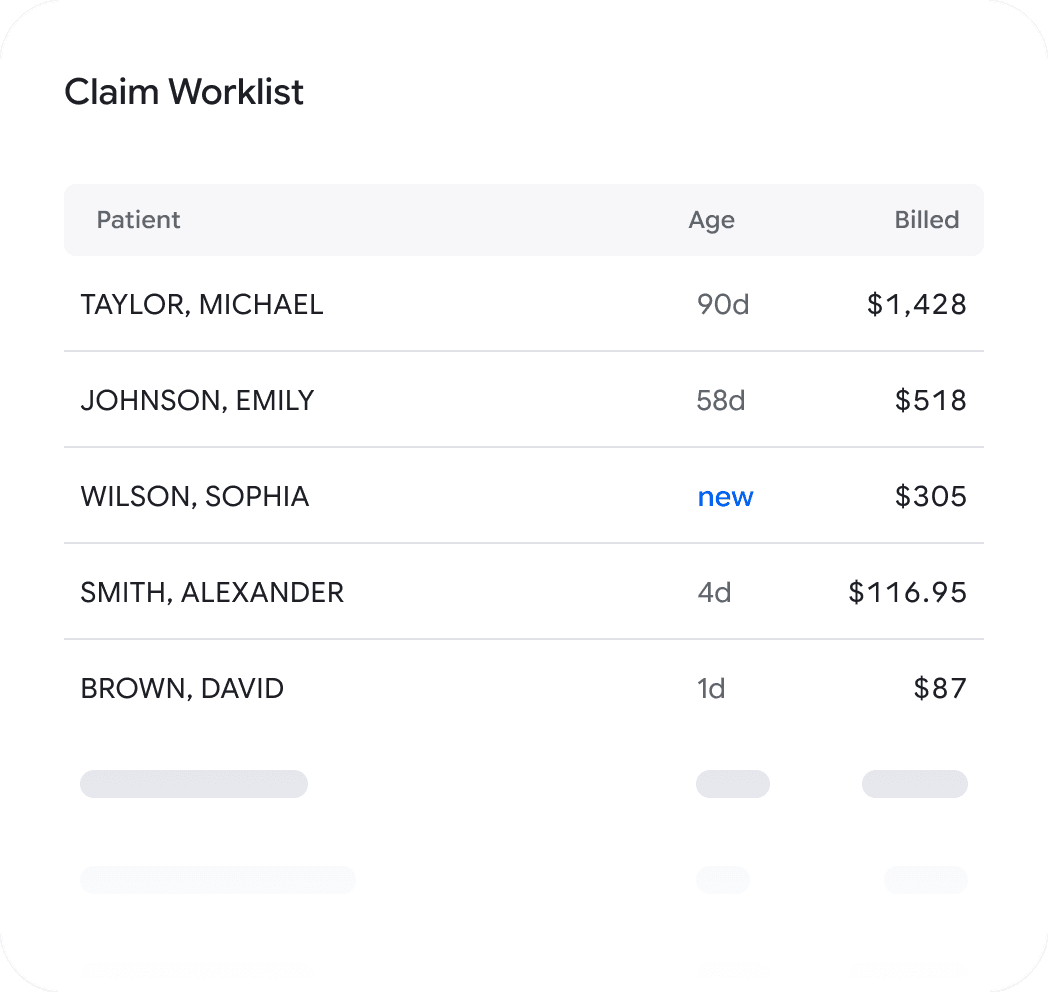

The cycle, stage by stage
Where most RCM platforms stop, and what Klar does past that line.
| Stage | What most platforms do | What Klar adds |
|---|---|---|
| Eligibility and registration | Check coverage before the visit and flag mismatches. | Nothing new. This is well covered elsewhere and Klar leans on what you already run. |
| Coding and charge capture | Turn documentation into billable charges, usually inside the EHR. | Shows what this payer usually allows for the claim, from your own remittance history, before it goes out. |
| Claim submission | File through a clearinghouse, scrub for format errors first. | Checks every claim against what this payer actually pays before it goes, shows you anything it changes, and files it — same clearinghouse, no re-enrollment. |
| Payer response | Post the payment. Put anything that was not paid in full onto a work queue. | Reads the remittance, decodes the reason and remark codes, and states what the payer is actually asking for. |
| Denials and underpayments | Show a prioritized list, usually by age, and hand it to a biller. | Ranks by recoverable dollars and remaining filing time, then drafts the correction or appeal for approval. |
| Patient balance | Statements and payment plans once insurance has adjudicated. | Nothing new. Klar's work finishes when the payer side is settled. |
Where Klar sits in your stack
Your EHR stays
Klar connects to the EHR you already run and takes billing off its hands. Clinicians keep working where they work; your billing team stops living in a screen that was designed for charting.
No migration, no parallel patient record, no change to how encounters are documented.
Your clearinghouse stays
Claims keep routing the way they route today, and Klar reads the remittance files you already receive. There is no payer re-enrollment, which matters because re-enrolling as a new remittance receiver would cut off your existing feed.
Claim data is handled under signed agreements.
Questions about RCM software
Still unsure? Contact usSoftware that manages the revenue cycle of a healthcare organization: turning a documented encounter into a claim, filing it, tracking the payer response, posting payment, working denials and underpayments, and billing the patient for what remains. It is the money side of a practice, as distinct from the clinical record.
Revenue cycle management. The cycle runs from registration and eligibility, through coding and claim submission, to payment posting, denial management and patient collections.
The category spans EHR-attached billing modules, standalone clearinghouse-led platforms, and full outsourced services, and the honest answer is that the right one depends on where your cycle is leaking. If claims go out clean and the money stalls after adjudication, rank candidates on what they do with a denial rather than on feature count.
Yes — it is the standard term for the administrative process of getting a provider paid for care already delivered, and every practice does it whether or not they call it that. The question worth asking is not whether the category is real but whether a given vendor can show you claim-level activity rather than a monthly summary.
No. Klar connects to the EHR you already run and takes billing off it. Clinical documentation stays exactly where it is.
On performance, as a share of the additional revenue the platform recovers, rather than per seat or per claim. If nothing extra is collected there is nothing to pay for.