Behavioral health claims get denied for reasons a general biller never sees
Behavioral health billing services handle claim submission, denial work and collections for mental health, psychiatry and substance use practices. The work differs from general medical billing in specific ways — time-based coding, session limits, prior authorization and carve-out plans — and those differences are where the money goes missing.
- Carve-out plans handled
- Telehealth and place-of-service rules
- Klar works live behavioral health claims
Five things that break behavioral health claims
None of these are exotic. They are ordinary features of behavioral health billing that general billing workflows are not shaped around.
Time-based coding
Psychotherapy codes are defined by session length, so the code has to match the documented duration. A mismatch between the note and the code is a denial that looks like a coding error and is really a documentation one.
Carve-out plans
Behavioral health benefits are frequently administered by a separate managed-care organization rather than the medical payer on the card. A claim sent to the medical payer comes back refused because it was never their benefit to pay.
Prior authorization and session limits
Many plans authorize a fixed number of sessions. Care continues past the authorized count more often than the authorization gets renewed, and the denial arrives weeks later.
Telehealth modifiers and place of service
Behavioral health moved to telehealth faster than most specialties, and payer rules on modifiers and place-of-service codes still differ from each other and change between plan years.
Provider type and incident-to rules
Who rendered the service matters — license level, supervision arrangement and whether the rendering provider is credentialed with that plan. The same session billed under the wrong NPI is refused.
The denial arrives weeks after the session
A behavioral health practice runs on a full calendar. The clinician sees clients, the notes get written, the claims go out, and the remittance comes back two or three weeks later saying the benefit sits with a carve-out plan, or the authorized sessions ran out four appointments ago.
At that point nobody in the practice has that client's plan details in their head any more. Reconstructing what happened means going back through the authorization, the eligibility check and the notes — for one claim, while the calendar keeps filling.
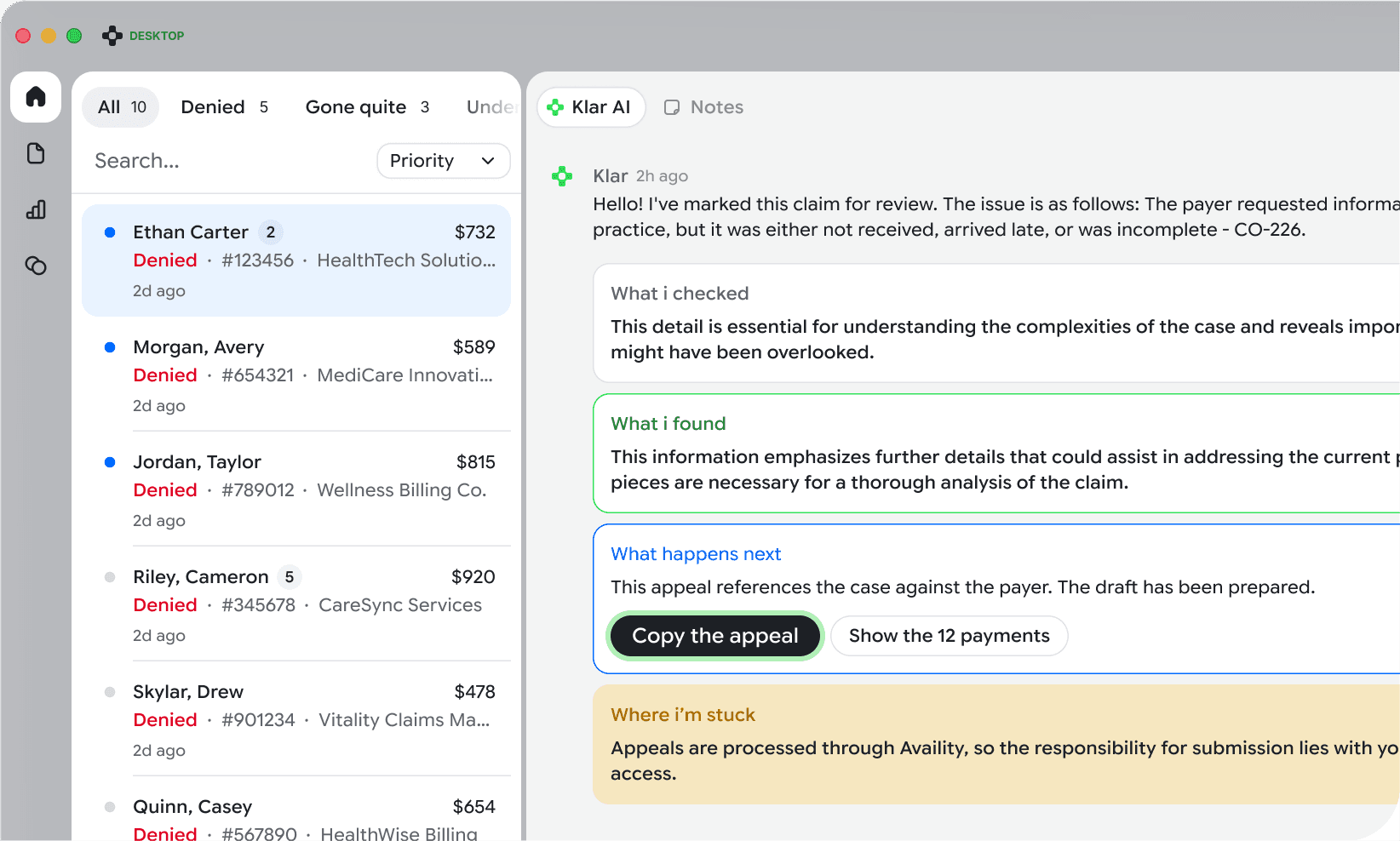
Klar reads the remittance as it comes in, states which of those five things the payer is actually objecting to, and drafts the correction or the appeal with the evidence attached.




The codes that carry the volume
The core outpatient behavioral health set. Verify current descriptors and payer rules against the CPT code set and each plan's policy before billing — these change between plan years.
| Code | What it covers | Where it goes wrong |
|---|---|---|
| 90791 / 90792 | Diagnostic evaluation, without and with medical services. | Frequently limited to one per episode of care per provider. A second evaluation, or one billed by a second clinician in the same practice, gets refused as a duplicate. |
| 90832 / 90834 / 90837 | Individual psychotherapy at roughly 30, 45 and 60 minutes. | The billed code has to match documented session time. 90837 in particular draws payer scrutiny when it is the default for a whole caseload. |
| 90833 / 90836 / 90838 | Psychotherapy add-on codes billed alongside an E/M service. | Add-ons refused when the base E/M is missing, downcoded, or billed by a provider not eligible for the E/M. |
| 90846 / 90847 | Family psychotherapy, without and with the patient present. | Coverage varies sharply by plan, and the identified patient on the claim has to be the covered member. |
| 90853 | Group psychotherapy. | Per-participant billing rules and session limits differ by payer; group sessions are also a common target for authorization caps. |
| H-codes and state Medicaid sets | Community and rehabilitative services under state Medicaid programs. | State-specific and frequently revised. What was payable last plan year may not be this one, and the denial reads as a generic non-covered refusal. |
The two questions behavioral health practices ask
Do you understand carve-outs?
Yes. When a payer refuses a claim as not their benefit, Klar checks which other payer has actually paid for the same service before, and points the resubmission there rather than guessing.
That is the single highest-value pattern in this specialty, because a carve-out denial looks like a coverage problem and is really an addressing one.
What about 42 CFR Part 2?
If your practice runs a federally assisted substance use disorder program, 42 CFR Part 2 applies alongside HIPAA, with its own rules on disclosure.
Tell us during onboarding rather than after. The handling differs, and it is not something to discover once claims are already flowing.
Questions behavioral health practices ask
Still unsure? Contact usThird-party billing services for behavioral health are usually paid a percentage of what they collect. Klar is priced on a share of the additional revenue recovered instead, which suits a specialty where most claims are small.
Verify the benefit first — including whether it is carved out to a separate behavioral health plan — then confirm any prior authorization and remaining session count. Document session duration, because the psychotherapy codes are time-based, and bill under the rendering provider credentialed with that plan. Most behavioral health denials trace back to one of those four steps rather than to the coding itself.
Practice management systems built for behavioral health handle scheduling, notes and claim submission well. Where they are generally weakest is after the payer responds: the denial arrives as a line on a report rather than as an explanation and a next step. Judge any option on what it does with a denial, not on how easily it files a clean claim.
A common cause in this specialty is a carve-out: the medical payer on the insurance card does not administer the behavioral health benefit, so the claim went to the wrong place. It reads as a coverage refusal but the service is often payable by a different plan, which is why the resubmission matters more than the appeal.
Yes, but flag it during onboarding. If your program falls under 42 CFR Part 2, it has its own disclosure rules alongside HIPAA, so the handling has to be set up correctly before claims flow rather than corrected afterwards.
No. Klar connects to the behavioral health EHR you already run and reads the remittance files you already receive. Scheduling and notes stay exactly where they are.