Therapy claims are small, frequent and easy to lose
Billing services for therapists handle insurance claims for counselors, clinical social workers, marriage and family therapists and psychologists. Each claim is small, the volume is high, and denials cluster around the same few causes: session time that does not match the code, a clinician not credentialed with the plan, and benefits carved out to a separate behavioral health payer.
- Counselors, social workers, MFTs, psychologists
- Credentialing-driven denials separated out
- Works with your practice's EHR
Four causes behind most therapy denials
Individually these are simple. At therapy volumes — dozens of sessions a week per clinician — they are where a practice quietly loses money.
Session time and the code
The psychotherapy codes are defined by time: 90832 covers 16 to 37 minutes, 90834 covers 38 to 52, and 90837 covers 53 minutes or more. The note has to support the time the code claims.
Credentialing
A claim from a clinician who is not credentialed with that plan — or whose credentialing lapsed — is refused however good the session note is. In group practices the rendering and billing provider also have to be set up correctly.
Carve-outs and session limits
Many plans hand the behavioral health benefit to a separate managed-care company, and many cap the number of covered sessions or require authorization after a set number.
Who can bill what
Licensure determines which codes a clinician can bill. Psychologists bill testing codes most other therapists cannot, and no non-prescribing clinician can bill the E/M codes a psychiatrist uses.
The same denial, fifty times a month
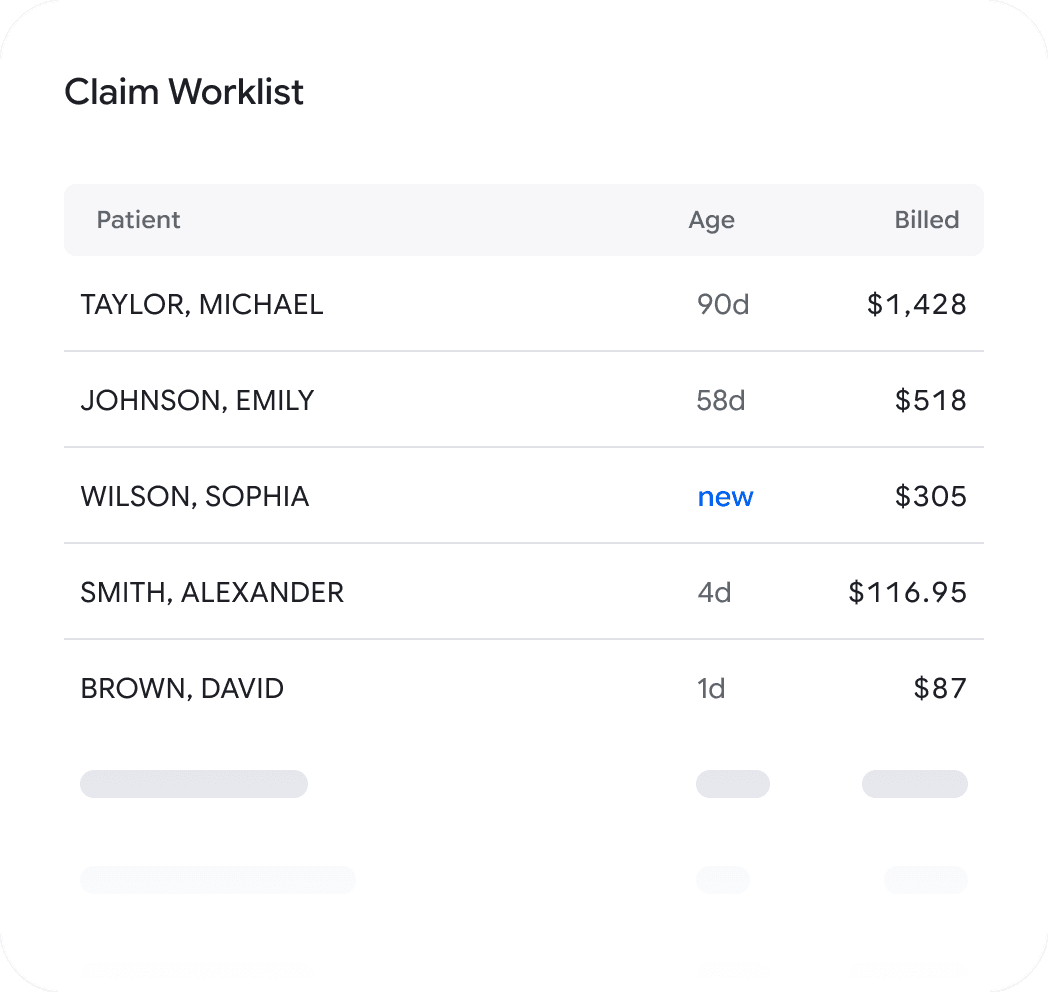
A single refused therapy claim is not worth an afternoon. That is exactly the problem: a practice that sees two hundred sessions a week can have the same credentialing or carve-out denial repeating across dozens of claims before anyone notices it is one fixable cause.
Worked one at a time, those claims never reach the top of the pile. Worked as a group — same payer, same reason, same fix — they are one afternoon's work.
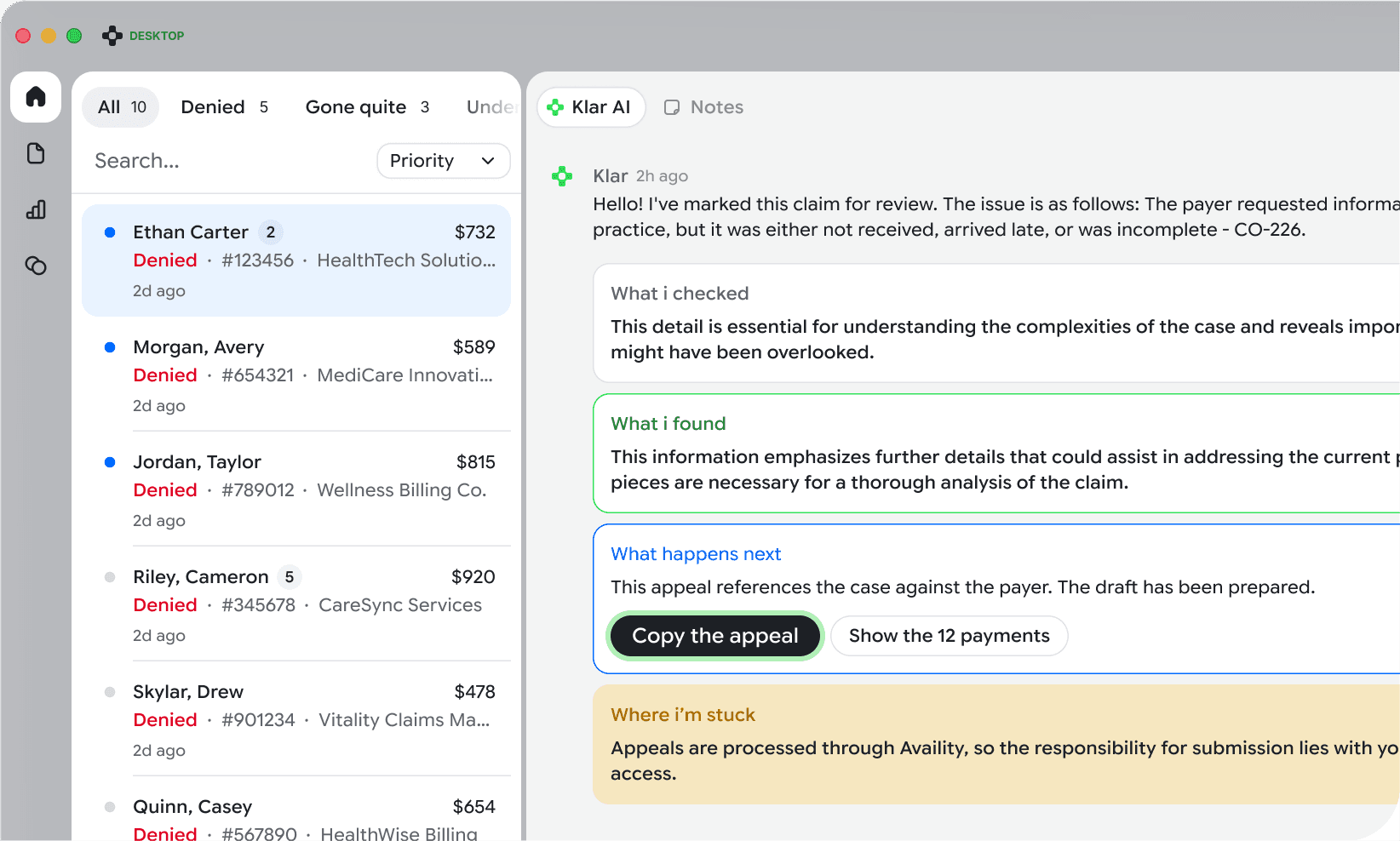
Klar groups denials that share a payer and a reason, so a pattern is fixed once and applied to every claim it affects, with a person approving the batch.


The codes therapy practices bill most
Outpatient psychotherapy and testing. Verify current descriptors against the CPT code set and each plan's policy before billing.
| Code | What it covers | Where it goes wrong |
|---|---|---|
| 90791 | Psychiatric diagnostic evaluation without medical services — the non-prescriber's intake. | Often limited to one per episode of care. A second intake by another clinician in the same practice can be refused as a duplicate. |
| 90832 / 90834 / 90837 | Individual psychotherapy, by session time. | The note has to support the time. 90837 draws the most scrutiny, especially when it is used for nearly every session. |
| 90846 / 90847 | Family psychotherapy, without and with the patient present. | The identified patient on the claim must be the covered member, and coverage for family work varies sharply by plan. |
| 90853 | Group psychotherapy. | Billed per participant, and a common target for session caps and authorization limits. |
| 96130 / 96131, 96136 / 96137 | Psychological evaluation, and test administration and scoring — billed by psychologists. | Frequently require prior authorization, and payers limit the number of units per assessment. |
Two questions therapy practices ask
Can Klar tell a credentialing denial from a coding one?
Yes. The payer's reason and remark codes say which it is, and Klar reads them for every claim. A credentialing problem is surfaced as a credentialing problem — with the clinician and plan named — instead of sitting in the same queue as coding corrections.
Fixing the credentialing itself is work your practice or a credentialing service does. Klar makes sure you know it needs doing, and which claims are waiting on it.
We're a small practice. Is this worth it?
In therapy, each claim is often too small to chase individually, and small practices rarely have a dedicated biller.
Klar is priced on a share of the additional revenue it recovers, so a practice that is already collecting everything pays nothing extra.
Questions therapists ask
Still unsure? Contact usNo. Psychotherapy codes are reported once per session, so a second unit of 90837 is refused. 90837 is defined as 53 minutes or more with no upper limit, so a longer session is still one unit of 90837 — document the actual start and stop times. The old prolonged-service add-ons, 99354 and 99355, were deleted in 2023.
Get credentialed with each plan you want to bill, verify the client's behavioral health benefit — including whether it is administered by a separate carve-out plan — and check whether authorization is required. Then bill the code that matches the documented session time, under the right rendering and billing provider. Most denials trace back to one of those steps rather than to the code itself.
Most charge a percentage of what they collect. Klar is priced on a share of the additional revenue it recovers instead.
For most therapy practices the question is not submission — every platform files a clean claim — but what happens when the payer refuses one. Look for something that tells you why each claim was refused and groups repeating causes, because at therapy volumes the pattern matters more than any single claim.
Yes, since January 1, 2024. Marriage and family therapists and mental health counselors can enroll in Medicare Part B and are paid at 75% of the rate for a psychologist. They have to enroll with Medicare individually before billing.