Psychiatry claims fail in the combination, not the code
Psychiatric billing services handle claims for psychiatrists and psychiatric nurse practitioners, whose visits often pair a medical evaluation with psychotherapy. That pairing — an E/M code plus a time-based add-on — is where many psychiatry denials come from, alongside prior authorization, carve-out plans and rules about who rendered the service.
- E/M and add-on pairing checked
- Nurse practitioner billing
- Telepsychiatry rules
Four things that break psychiatry claims
Psychiatry sits between medical and behavioral billing, and it inherits the failure points of both.
Two services, one visit
A medication-management visit with therapy is billed as an E/M code plus a psychotherapy add-on. Both have to be supported by the note separately — the E/M on its own medical decision-making or time, and the add-on on time spent in therapy, which cannot also be counted toward the E/M.
Who rendered it
Nurse practitioners billing Medicare under their own number are paid at 85% of the physician rate. Billing under a supervising psychiatrist instead is only allowed when incident-to requirements are met, and those are narrower than many practices assume.
Carve-outs and authorizations
As in the rest of behavioral health, the benefit is often administered by a separate managed-care plan, and ongoing treatment can need an authorization that expires before the treatment does.
Telepsychiatry
Psychiatry runs heavily on telehealth, and payers still differ on the place-of-service code and modifier they expect — and change them between plan years.
The add-on gets refused and the visit looks paid
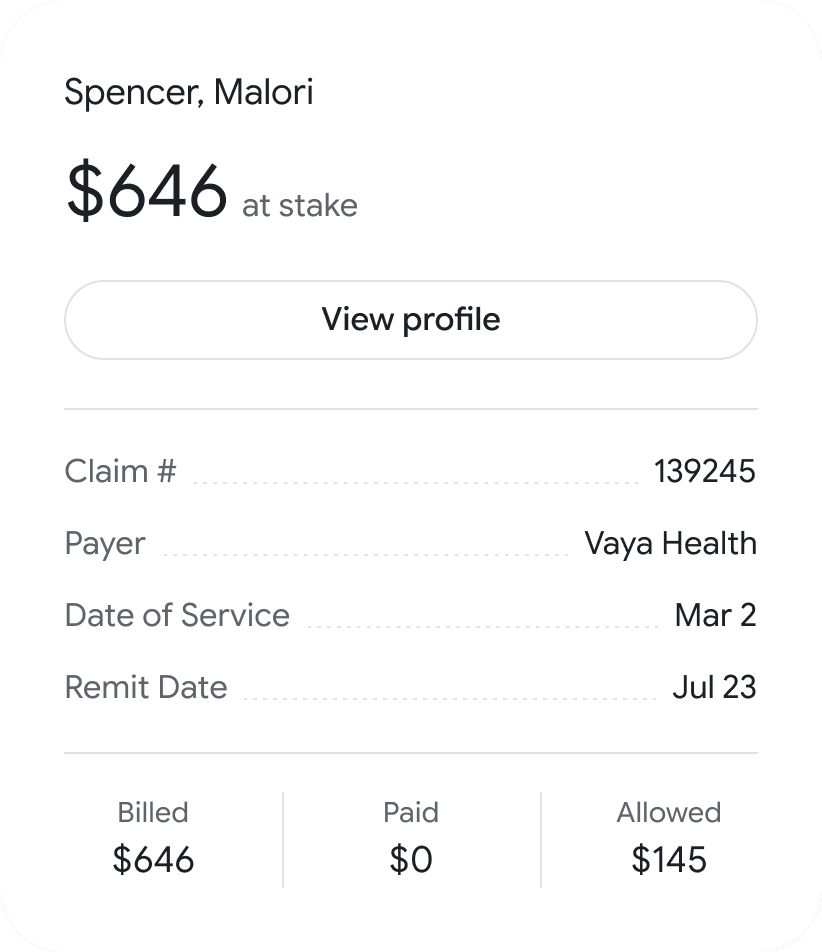
When a payer refuses the psychotherapy add-on but pays the E/M, the claim still shows a payment. On a busy day it gets posted and closed, and the add-on — often a significant part of the visit — is written off without anyone deciding to write it off.
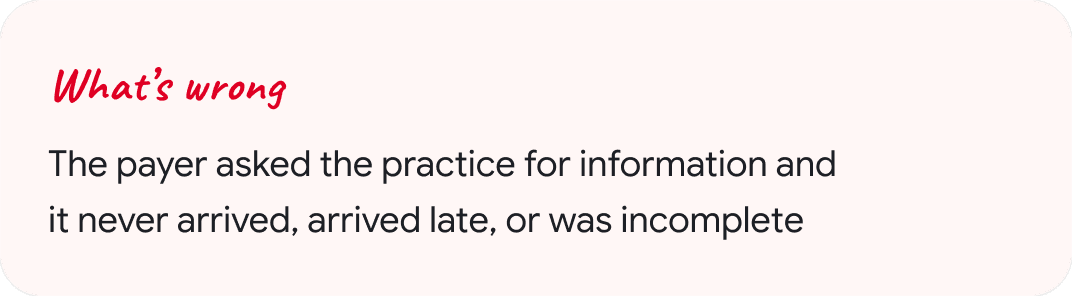
The reason is usually specific and fixable: the note did not separate therapy time from the medical work, the base E/M was downcoded, or the rendering provider was not eligible for the E/M on that plan.
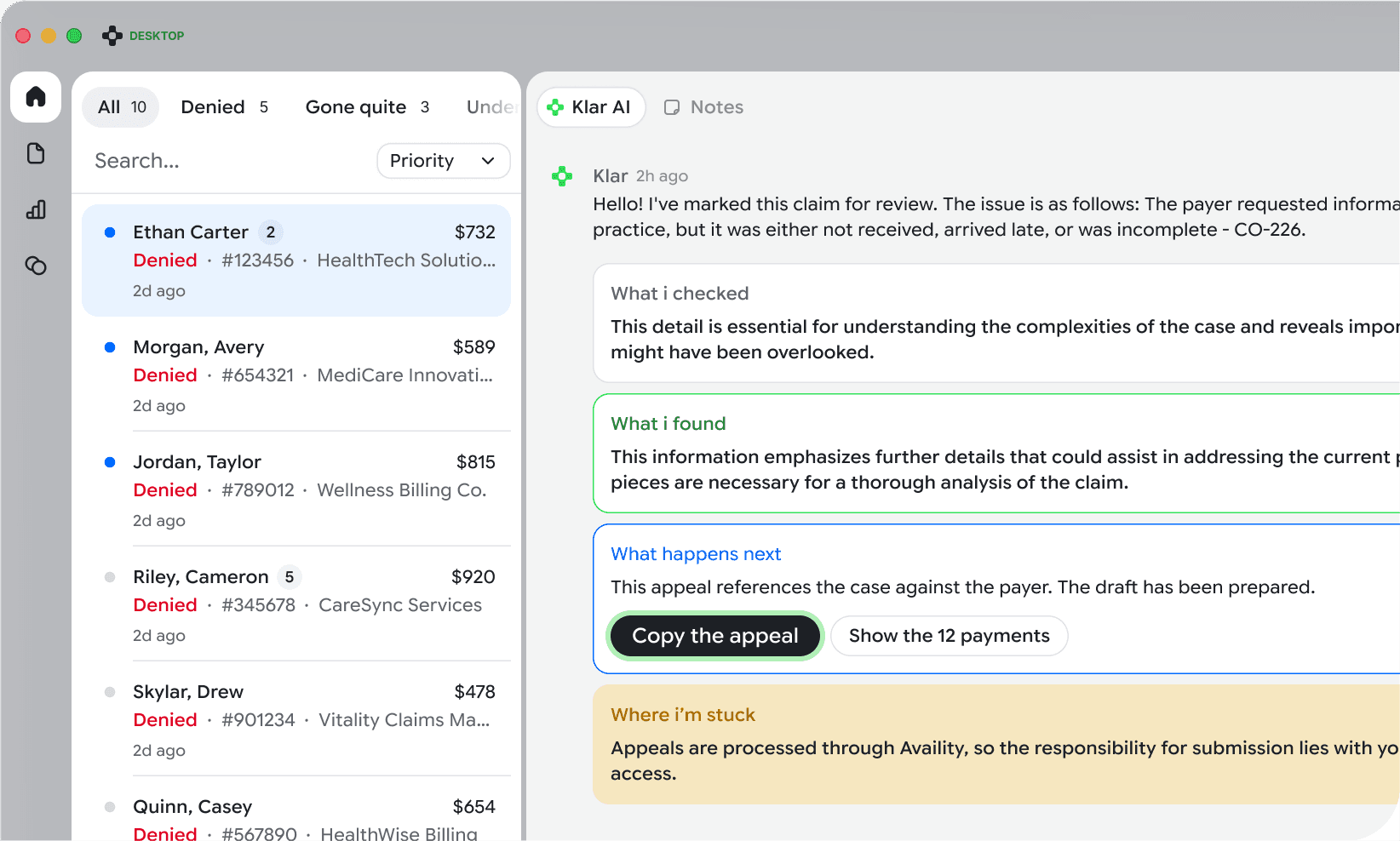
Klar reads every line of the remittance, not only the claim total, so a refused add-on on a paid claim is surfaced as its own item with the reason and a drafted correction.

The codes psychiatry runs on
The outpatient prescriber set. Verify current descriptors against the CPT code set and each plan's policy before billing — payer rules change between plan years.
| Code | What it covers | Where it goes wrong |
|---|---|---|
| 90792 | Psychiatric diagnostic evaluation with medical services — the prescriber's version of 90791. | Often limited to one per episode of care. Billing 90792 again for a routine follow-up, instead of an E/M, is refused. |
| 99212–99215 | Established-patient office visits, used for medication management. | The level has to be supported by medical decision-making or total time. When therapy is also billed, therapy time cannot be counted towards the E/M. |
| 90833 / 90836 / 90838 | Psychotherapy add-ons of roughly 30, 45 and 60 minutes, billed with an E/M. | Refused when the base E/M is missing, refused, or billed by a provider who is not eligible for it — and when the note does not document therapy time separately. |
| 90785 | Interactive complexity add-on, for communication factors that complicate the visit. | Only valid alongside specific codes, and payers expect the complicating factor to be named in the note. |
Two questions psychiatry practices ask
Do you handle nurse practitioner billing?
Yes. The payer's reason and remark codes say when a claim was refused because of who rendered the service, and Klar reads them on every claim — so a rendering-provider refusal is separated from a genuine coding problem instead of sitting in the same queue.
Whether a given visit can be billed incident-to is a compliance decision for your practice. Klar will show you where the payer disagreed; it will not make that call for you.
What about substance use treatment?
If your practice runs a federally assisted substance use disorder program, 42 CFR Part 2 applies alongside HIPAA, with its own rules on disclosure.
Tell us during onboarding. The handling has to be set up before claims flow, not corrected afterwards.
Questions psychiatry practices ask
Still unsure? Contact usA prescriber's first visit is often billed as 90792, the diagnostic evaluation with medical services, or as a new-patient E/M. Follow-ups are billed as an E/M visit, with a psychotherapy add-on — 90833, 90836 or 90838 — when therapy is also provided. The note has to support the E/M and document therapy time separately, and the claim has to go to whichever plan actually administers the behavioral health benefit.
Psychiatrists, psychiatric nurse practitioners and physician assistants bill the medical and prescribing services. Psychologists, clinical social workers, and — for Medicare since January 2024 — marriage and family therapists and mental health counselors bill therapy. Each has to be credentialed with the plan, and only physicians and advanced practice providers such as nurse practitioners and physician assistants can bill the E/M codes psychiatry relies on.
Most third-party billers for behavioral health charge a percentage of what they collect. Klar is priced on a share of the additional revenue it recovers instead, which suits a specialty where much of the loss is in partly-paid claims rather than outright denials.
It depends where your claims are failing. If they go out cleanly and money is lost when the payer responds — a refused add-on, a carve-out, an expired authorization — you need software that reads the remittance line by line and tells you what to do, not one that only files the claim.
Medicare pays nurse practitioners billing under their own number at 85% of the physician fee schedule, and many commercial plans follow a similar reduction. That is expected, not an underpayment. What is worth checking is whether a claim was refused outright because of the rendering provider, which is a different and fixable problem.