Physical therapy claims are counted in minutes
Physical therapy billing services handle claims for outpatient PT practices, where much of a visit is billed in timed units. Denials come from how those minutes turn into units, from Medicare's therapy modifiers, from a plan of care that was not certified in time, and from code pairs that payers bundle together.
- Timed and untimed codes
- GP, KX and CQ modifiers
- Plan-of-care deadlines surfaced
Four things that break physical therapy claims
Most PT denials are not about whether the treatment was needed. They are about how the treatment was counted and documented.
Timed units
Most treatment codes are billed per 15 minutes, and the number of units depends on the total timed minutes of the visit. A mismatch between the minutes in the note and the units on the claim is a common cause of PT denials.
Medicare's therapy modifiers
GP marks services under a physical therapy plan of care. KX goes on once a patient's therapy spending passes Medicare's annual threshold. CQ marks services provided in whole or in part by a physical therapist assistant, which Medicare pays at 85%.
The plan of care
A physician or qualifying practitioner has to certify the plan of care and recertify it on the payer's schedule. Treatment that runs past an expired certification gets refused weeks later.
Bundled code pairs
Some treatment codes are bundled under national correct coding edits when billed on the same day. When they were genuinely separate services, the claim needs a modifier that says so — and documentation that backs it.
How Medicare's 8-minute rule counts units
For Medicare, timed minutes across the whole visit are added up and converted to units. Some commercial payers count each code separately instead, so check each plan's policy.
| Total timed minutes | Billable units |
|---|---|
| Under 8 | 0 |
| 8 to 22 | 1 |
| 23 to 37 | 2 |
| 38 to 52 | 3 |
| 53 to 67 | 4 |
| 68 to 82 | 5 |
The unit count is the denial
A PT visit often mixes timed treatment with an untimed evaluation, and the timed minutes are split across several codes. Get the arithmetic wrong in either direction and the claim is refused or quietly cut back to fewer units than were delivered.
The second pattern is time running out on paperwork rather than treatment: the plan of care lapses, the recertification is not signed, and every visit after that date comes back refused together.
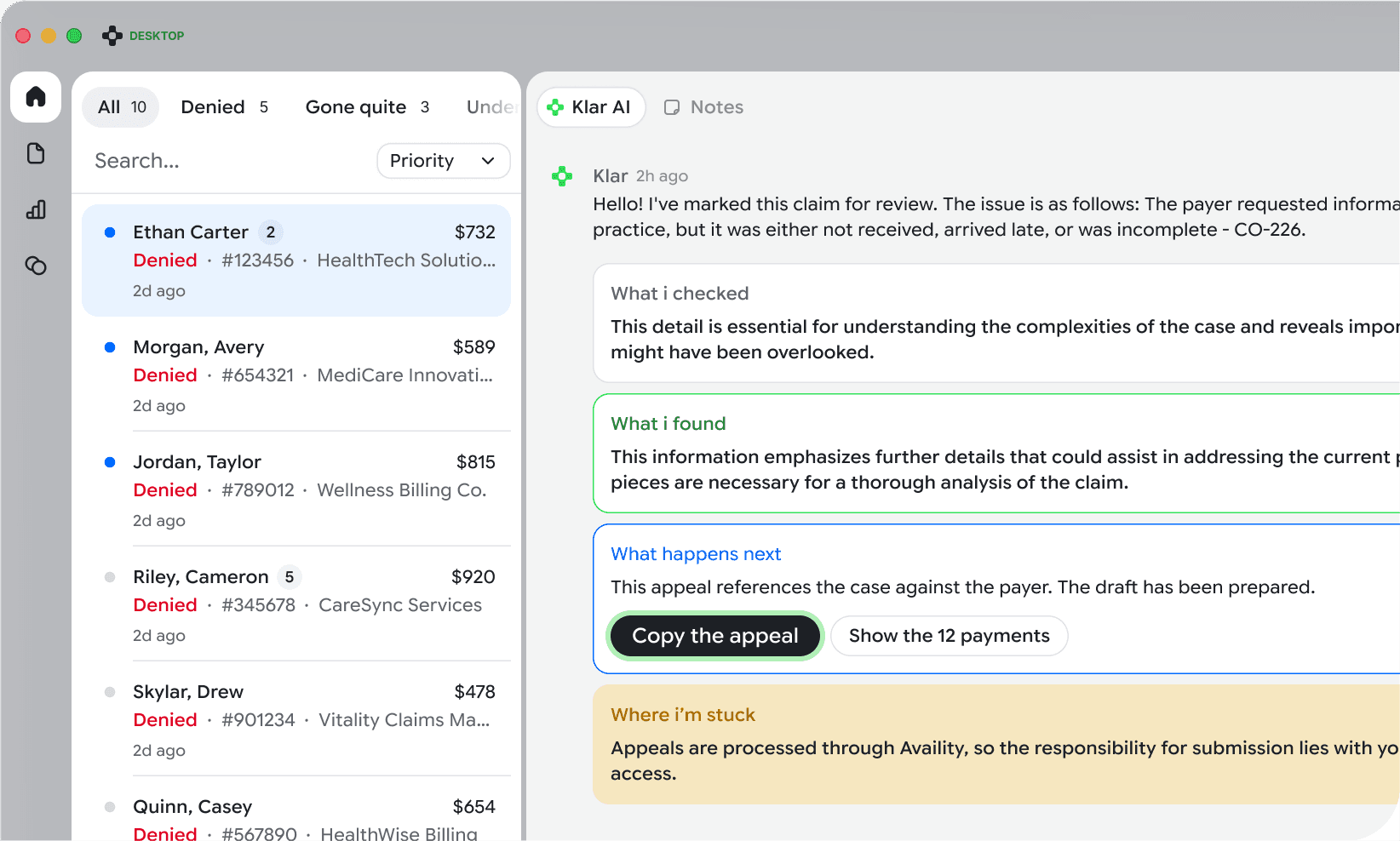
Klar reads the reason on every refused line — units, modifier, certification or bundling — and drafts the correction, so a cut-back unit is caught instead of being posted as paid.


Two questions PT practices ask
Do you handle hospital-based therapy?
No. Hospital outpatient therapy is billed on institutional claims, and Klar is built for the professional claims private practices submit. We would rather say so here than find out on an onboarding call.
If you run a private or physician-owned practice billing on a standard professional claim, you are who this is for.
What about patients who come without a referral?
Direct access rules depend on your state, and many payers still require a referral or signed plan of care before they pay, whatever state law allows.
Klar surfaces the claims a payer refused for missing referral or certification, so they can be corrected before the filing window closes.
Questions PT practices ask
Still unsure? Contact usIt is Medicare's method for counting timed units. You add up all the timed treatment minutes in a visit and convert the total: 8 to 22 minutes is one unit, 23 to 37 is two, 38 to 52 is three, and so on in 15-minute steps. Under 8 minutes of timed treatment is not billable as a unit. Some commercial payers count each code separately instead.
Bill the evaluation with the untimed evaluation code for its complexity level, then treatment with timed codes whose units match the documented minutes. For Medicare, add the GP modifier, add KX once the patient passes the annual therapy threshold, and add CQ where an assistant provided the service. All of it has to sit under a certified, current plan of care.
Most PT software handles scheduling, documentation and claim submission well. Judge the options on what happens after a claim is refused or cut back — whether it tells you the unit count was the problem and prepares the correction, or just lists the claim as short-paid.
Third-party billers for physical therapy usually charge a percentage of what they collect. Klar charges a share of the additional revenue it recovers instead, so the fee depends on money you would not otherwise have collected.
When a Medicare patient's outpatient therapy spending for the year passes the threshold Medicare sets annually, and the therapy is still medically necessary and documented as such. Without KX those claims are refused once the threshold is crossed.